


For decades, plaintiff-side litigation has relied on a reactive model. A breaking news story. A whistleblower. A walk-in client. A referral from a peer. Even the most sophisticated plaintiff firms have had limited tools to detect wrongdoing early enough, or at a large enough scale, to shape the next wave of high-value matters.
But in a world defined by massive datasets, fast-moving digital systems, evolving technical behavior, and a constant flow of public information, firms need a way to see patterns, trends, and shifts far earlier — and with richer context.
Darrow’s mission is to provide exactly that: an awareness layer that brings clarity, consistency, and transparency to complex legal and technical environments. The company maintains a 160-person team across engineering, data science, and legal research, producing analyses that help determine whether emerging signals can support a viable legal strategy.
Using AI-driven data analysis and deep human legal expertise, the company has surfaced insights that ultimately connected to more than $22 billion in potential legal opportunities, including early intelligence related to the issue that preceded a $40 million resolution involving Bumble’s parent company.
Here, we’re sharing a deep dive into how the system works, based on a demo from company executives Etia Rottman Frand and Mathew Keshav Lewis.
The Darrow Model: Detect. Evaluate. Address.
Darrow’s framework centers on three connected stages — Detect, Evaluate, and Address — that give firms early visibility into meaningful developments across the legal landscape.
1. Detect: Finding the Buried, Scattered Signals in the Noise.
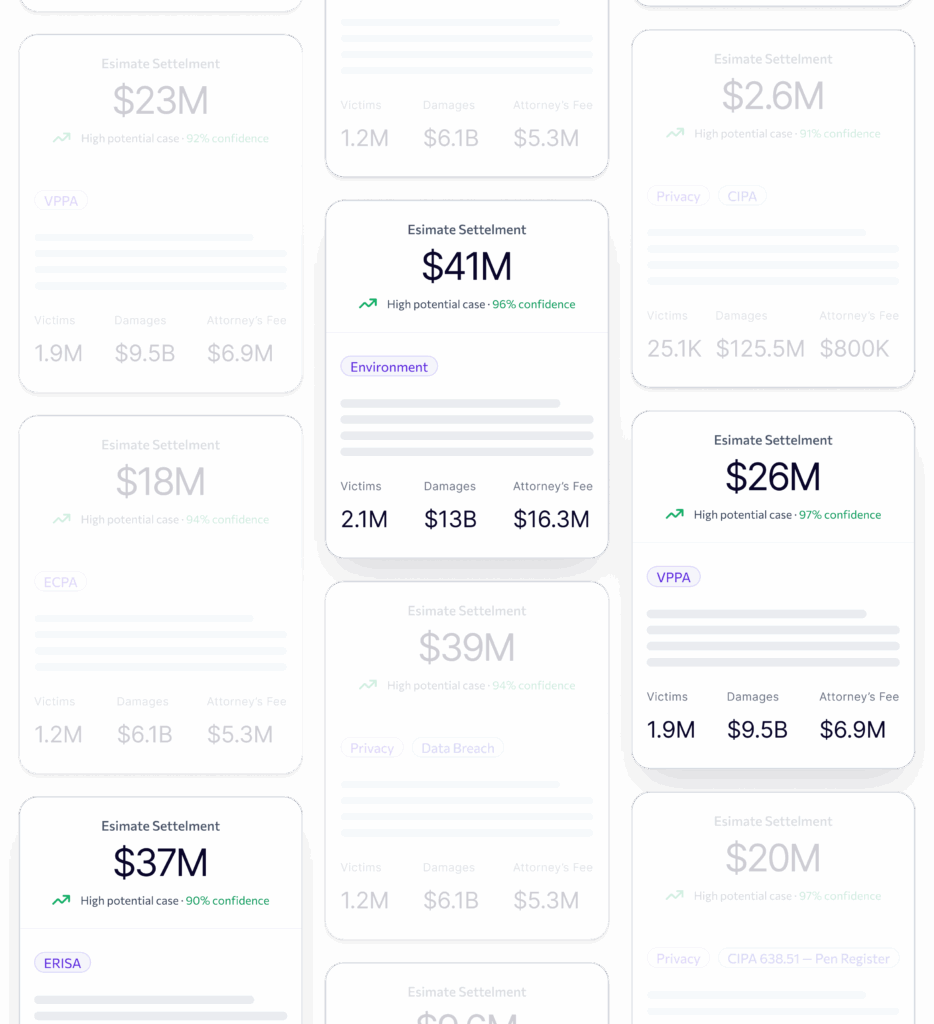
Darrow continuously analyzes billions of data points drawn from an expansive set of public and technical sources, including federal and state regulatory databases, government health and safety data, court filings, corporate and industry datasets, digital systems behavior (such as web and app data flows), trade publications, and open-source online discussions.
By unifying these signals, Darrow creates an early, high-clarity view of meaningful patterns, trends, and developments across a wide range of practice areas. This isn’t about assuming wrongdoing — it’s about giving firms transparent, data-backed awareness of areas that may warrant deeper investigation.
2. Evaluate: Turning Signals into Clear, Actionable Understanding.
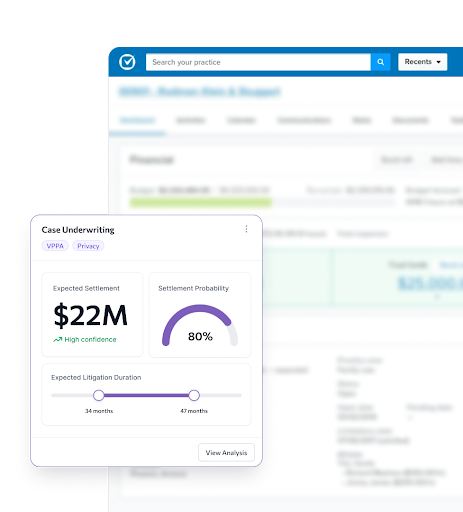
Once a signal surfaces, Darrow’s attorneys, researchers, and technical specialists work together to interpret what the data actually means. This evaluation stage includes:
• Predictive Underwriting: building case-level financial forecasts grounded in evidence, comparable matters, and litigation trends, helping litigation teams shape strategy and evaluate risk.
• Legal and technical review: aligning the observed pattern with the relevant statutes, regulatory frameworks, and precedent, and determine whether it meets structured criteria for moving forward.
• Scientific, medical, or technical insight: in areas like medical products, environmental data, or digital systems, Darrow provides the context needed to understand why a pattern is emerging, and whether it meets necessary thresholds.
• Portfolio-level clarity: helping firms determine case quality settlement outcomes and timing, and revenues across a portfolio of cases to improve firm resilience.
• AI support through Torch: Darrow’s integrated assistant summarizes, studies, explains terminology, surfaces related filings, and helps teams navigate complex supporting data.
This process gives firms a complete and comprehensible view of what the data suggests — allowing them to make informed decisions backed by a strong evidentiary foundation. Support through Torch, Darrow’s integrated AI assistant, studies, summarizes content, explains terminology, surfaces related filings, and helps teams navigate complex supporting data.
3. Advance: Moving Forward with Clarity and Confidence.
Whether a matter is surfaced by Darrow’s legal intelligence or originated through the firm, Darrow helps support ongoing strategy and case development by:
• Identifying and qualifying potential representative individuals
• Expanding and enriching relevant datasets
• Providing scientific, technical, or digital-system context
• Validating or challenging new information as it surfaces
• Structuring an evidentiary foundation that allows legal teams to focus on strategy
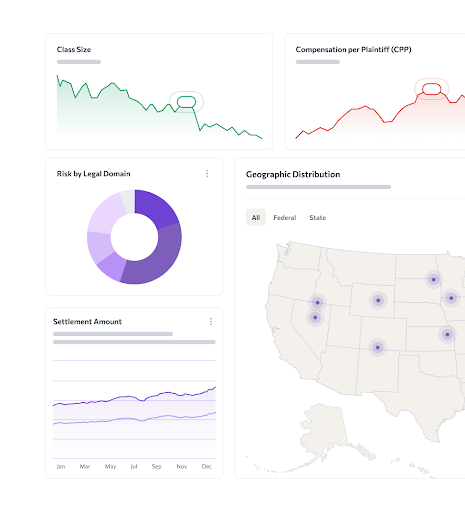
• Analyzing pattern clarity: analyzing large-scale trends, cohorts and population-level outcomes to understand whether observed events are isolated incidents or part of a broader, legally meaningful pattern.
Darrow supplies the intelligence infrastructure that strengthens and accelerates the clients ability to proceed confidently and efficiently.
Real Examples of Legal Intelligence in Action
Darrow’s legal intelligence is designed to support the practice areas that demand both scale and depth — where the underlying information is vast, technical, and often fragmented across dozens of public sources. The company works across a broad set of fields that routinely require advanced analysis, including:
• Consumer Protection: analyzing patterns in pricing, advertising, disclosures, and product behavior across large datasets.
• Privacy & Digital Technologies: understanding how websites and apps communicate, share data, and operate at a technical level.
• Environmental & Public Health: examining state and federal reporting systems, community-level data, and scientific records.
• Financial & Securities: assessing publicly available disclosures, regulatory filings, and market patterns.
• Antitrust & Competition: reviewing structural market data, pricing signals, and competitive dynamics.
• Employment & Labor Practices: synthesizing reporting, filings, and regulatory updates across federal and state systems.
• Medical Products & Life Sciences: interpreting adverse event data, clinical literature, and regulatory timelines.
Because each practice area has its own data environment, technical constraints, and legal frameworks, Darrow custom-builds workflows and analytical models that reflect the realities of how these practice areas operate. It’s not one generalized tool applied everywhere — it’s a unified intelligence layer supported by topic-specific research, domain expertise, and rigorously validated data pipelines.
This is what allows Darrow to deliver early, evidence-backed clarity in sectors where traditional research or manual review simply can’t keep up with the pace or complexity of the information.
Below are examples of how this intelligence comes together in practice.
Medical Products: Making FDA Data Legible and Useful
The FDA’s adverse event system is one of the richest public datasets in healthcare, and also one of the most complex. Reports are narrative, inconsistent, and sprawling. Without specialized tools, lawyers would need to read through thousands of pages just to understand the landscape.
Darrow restructures and analyzes this information by:
• Classifying clinical severity with AI
• Mapping demographic trends
• Aligning adverse events with timeline changes (such as label updates)
• Linking each event to relevant scientific literature
• Visualizing patterns that may be legally significant
This system instead uses large language models to rank adverse reactions by severity and frequency. It then cross-references these metrics with published medical studies and demographic data.
If an attorney wants to know whether patients were adequately warmed about a side effect, they can filter adverse events by severity and see when a warning label was updated. If a condition like kidney failure appears frequently before it was added to the label, that discrepancy becomes important context for evaluating whether a matter merits deeper exploration.
Torch, Darrow’s AI legal assistant tool, supports this workflow by summarizing studies, clarifying medical terms, and identifying related filings — giving attorneys a complete, contextual picture of what the data suggests.
Consumer Pricing: Tracking Multi-Month Patterns Automatically
California’s pricing laws depend on precise timing — whether a “sale” price has been displayed continuously for a specific period. Proving this manually would require daily tracking of every product for months.
Darrow automates this entire process:
• Capturing daily snapshots of product pricing
• Extracting structured data on sales, discounts, and history
• Tracking thousands of items over multi-month periods
• Surfacing long-term pricing patterns in a single dashboard
This transforms a manual, near-impossible task into a transparent, evidence-backed understanding of pricing behavior over time.
Privacy & Digital Technologies: Clarifying How Apps and Websites Actually Behave
Digital systems often generate information that isn’t visible through traditional legal research. Whether reviewing a patient portal, a retail app, or a large consumer-facing platform, Darrow analyzes:
• Network calls and data flows
• Third-party trackers and integrations
• Backend system behavior
• Disclosures and consent flows
• Changes over time in how data is transmitted
This provides attorneys with clear, technical visibility into how a digital product operates in practice — and whether that aligns with what users are told. Darrow’s legal and technical teams then place this information into the appropriate regulatory and statutory context, giving firms the clarity they need to evaluate whether the matter warrants further action.
Environmental & Greenwashing: Understanding Public Data in Context
Environmental and sustainability-related claims often involve large amounts of publicly available information distributed across different reporting systems. Darrow brings that together:
• Federal and state environmental reports
• Geographic and land-use data
• Scientific and toxicology literature
• Product-level sustainability claims
• Public disclosures and marketing materials
• Community-level or industry-specific reporting
By unifying environmental, scientific, commercial, and geographic datasets, Darrow helps attorneys understand whether real-world activity matches public representations — or whether there are patterns worth looking at more closely.
Why Leading Plaintiff Firms Are Turning to Legal Intelligence
Modern litigation increasingly relies on understanding:
• Large, distributed datasets
• Technical system behavior
• Dynamic regulatory environments
• Emerging patterns at scale
Darrow helps firms see the landscape clearly — earlier, with richer context, and with greater confidence.
For plaintiff firms, this means more informed decisions, stronger early foundations, and clarity on where to focus resources. For corporate legal teams and insurers, it provides transparent, data-backed visibility into topics that matter within their industries.
The goal is the same on all sides: enable fair, informed, and consistent legal processes.
Experience Legal Intelligence Firsthand
Darrow is building the legal system’s missing awareness layer — helping firms detect, evaluate, and advance opportunities with transparency, clarity, and technical depth.
To explore how legal intelligence works in practice, you can schedule a demo here.
The post How Legal Intelligence Is Bringing In A New Era Of Litigation For Plaintiff Firms appeared first on Above the Law.