

A few weeks ago, Gordon Rees found itself on the wrong end of a court filing flagging a number of misleading if not completely wrong citations that looked an awful lot like someone told ChatGPT “make me legal filing!” and hit enter. This would be a problem for any firm, but for Gordon Rees, this was at least its third brush with AI trouble — having previously admitted to filing a brief riddled with AI hallucinations in October and then received a reprimand for filings with citations that “do not support the specific explanatory phrase” in December.
As we wrote about the most recent accusation, “Whether any specific citation was generated by AI — indeed, whether any specific citation is even wrong as opposed to merely debatable — opposing counsel now has every incentive to scrutinize any citation out of the firm with a jeweler’s loupe.”
After that article, BriefCatch founder Ross Guberman offered me a sneak peek at RealityCheck, the company’s new authority verification tool. Essentially, the product picks up where my jeweler’s loupe analogy left off, providing a superpowered hallucination check for lawyers. Running it against the original brief from the October Gordon Rees story that the firm already acknowledged to contain hallucinations, the RealityCheck tool delivered exactly what you’d want as opposing counsel.
Or, ideally, the senior partner reviewing your own brief before signing your name to a bunch of hallucinatory nonsense.
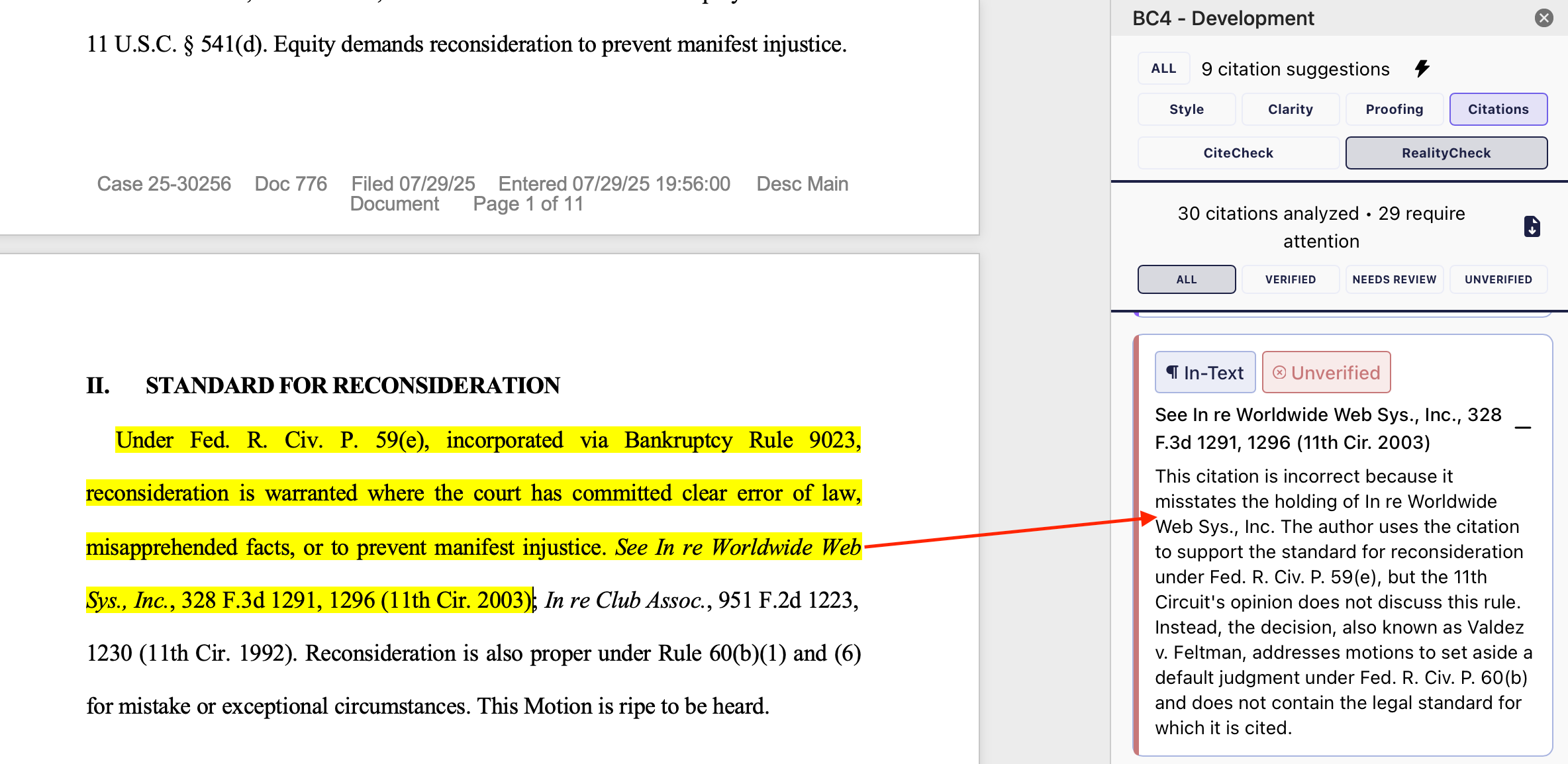
At the time, RealityCheck’s splashy announcement launch remained a few weeks off, but with its Legalweek-timed roll out, we can now talk a little about the new essential tool for the LitigationSlop era.
Lawyers, ideally, painstakingly review every case in every filing. But, at this point, you can’t even trust the Department of Justice to check its briefs, let alone your adversaries (or, perhaps, your first-year associates). RealityCheck isn’t trying to replace the process of cite checking, but it is trying to get it done faster and with more certainty.
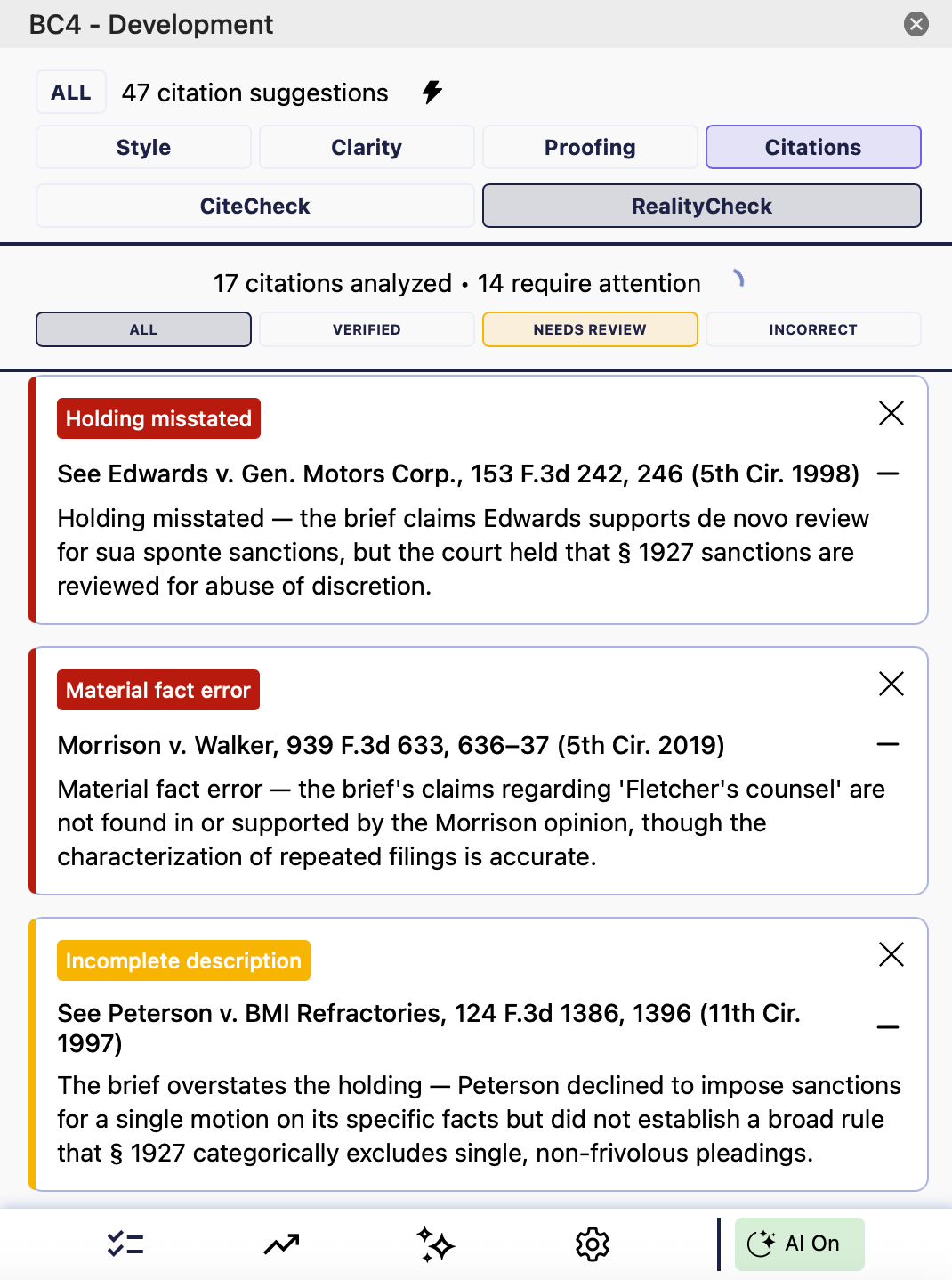
The tool uses a two-layer verification process, combining deterministic citation validation — checking reporter volumes, court identifiers, and case names against authoritative legal databases all without any AI involvement — with AI-assisted analysis that then evaluates the quoted language to make sure it actually appears in the cited opinion and actually supports the proposition it’s cited for. Every citation is then scored visually with a Green-Verified, Yellow-Caution, or Red-Incorrect label and explained for the reviewer.
BriefCatch performed a detailed case study on the Fifth Circuit’s recent decision in Fletcher v. Experian Information Solutions, where the court flagged fabricated quotations, misstated holdings, and citations resolving to entirely different cases. This is what the offending filing would look like for a RealityCheck user:
Unfortunately, this isn’t a problem that’s likely to go away. Researcher Damien Charlotin has now catalogued over 1,000 legal cases involving AI hallucinations. Lawyers have started blaming legal AI research tools themselves for introducing errors into their briefs — which is a bit like blaming a vending machine for not giving you steakhouse dinner — but it speaks to the reality that lawyers increasingly rely on tools for accuracy and mistakes follow. This is how those get caught.
BriefCatch is making it available to its federal and state court clients. As Guberman put it: “Once courts are running filed briefs through RealityCheck, the calculus changes for every litigator. The question isn’t whether to verify your citations. It’s whether you want the court to find the errors before you do.”
Smart play to put the screws to the entire legal market like that.
 Joe Patrice is a senior editor at Above the Law and co-host of Thinking Like A Lawyer. Feel free to email any tips, questions, or comments. Follow him on Twitter or Bluesky if you’re interested in law, politics, and a healthy dose of college sports news. Joe also serves as a Managing Director at RPN Executive Search.
The post New Tool Catches AI Hallucinations In Legal Briefs appeared first on Above the Law.