

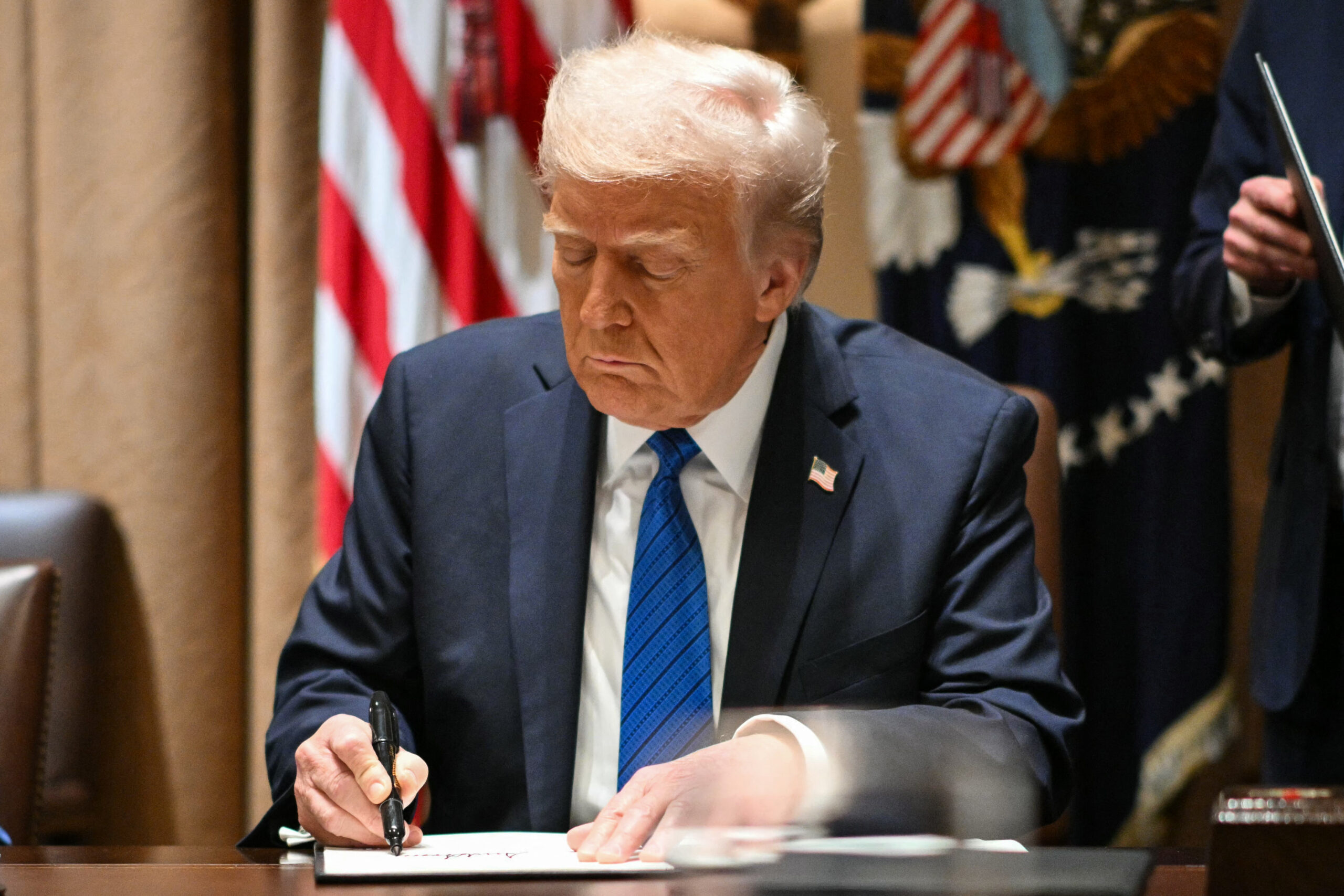
President Donald Trump’s signature tariffs are being scrutinized by the Supreme Court after they were struck down by both the Court of International Trade and the Court of Appeals for the Federal Circuit. Many commentators believe a decision could come as soon as the end of the year, and the high court will not uphold the tariffs. But Trump claims that even if he loses, he has other ways to keep the tariffs in place, potentially shifting to alternative legal authorities like Sections 232 or 301 of existing trade laws.
So what is Trump trying to accomplish with the tariffs? Have they worked so far? And what should Trump do if they are overturned?
Since the 1980s, Trump has complained that the rest of the world was taking advantage of the U.S. or even “ripping the country off” through what he thinks are lopsided trade deals. He also said that the North American Free Trade Agreement ratified in 1994 was the worst deal ever made because it led to higher trade deficits with Canada and Mexico. Also, NAFTA resulted in lost U.S. jobs because large businesses moved their manufacturing to Mexico due to that country’s cheaper labor costs.
During his first term, Trump issued tariffs but they focused only on a few countries. But the most publicized tariffs were those imposed on China, which led to retaliatory tariffs (particularly on products made in red states) and a trade war. He also renegotiated trade deals with Canada and Mexico by replacing NAFTA with the new U.S.-Mexico-Canada agreement or USMCA.
But during his second term, Trump issued tariffs on almost every country, calling it “Liberation Day.” The tariffs ranged from 10% to over 50%. Only a few countries were exempt from Liberation Day tariffs, notably Mexico and Canada due to their existing agreements under USMCA. Curiously, North Korea, Cuba, Russia, and Belarus (known for having very close ties with Russia) were exempt from Liberation Day citing existing sanctions which made the tariffs redundant.
As legal support, Trump mainly relied on the International Emergency Economic Powers Act (IEEPA). IEEPA does not explicitly allow the president to issue tariffs. But it states that the president can only regulate imports to deal with an unusual or extraordinary threat. Trump has stated on numerous occasions that he believes the trade deficits are a threat to national security, even though none of his predecessors did.
Because of the unclear statutory language, the Supreme Court will decide (among other issues) whether the major questions doctrine applies to the tariffs. Do the tariffs have such a large political or economic significance to require clear Congressional authorization? The major questions doctrine was famously applied to disallow former president Joe Biden’s $10,000 cancellation of federal student loans. Biden’s loan cancellation program is estimated to have cost half a trillion dollars. The Liberation Day tariffs so far has brought in over $250 billion to date, and President Trump has bragged that the tariffs could bring in $1 trillion.
So how have the Liberation Day tariffs done so far? A Yale Budget Lab study believes the average household will lose $2,700 in purchasing power in 2025 due to the tariff’s inflationary effect on prices. This adds to the existing inflation problem that started a few years ago. Trump’s response has been to blame the inflation on former president Biden. Several countries have imposed retaliatory tariffs on American goods.
In response to the price increases, Trump proposed issuing $2,000 refund checks to every middle-class American, which could put a large hole on the tariff income. The rich would not be eligible, although no income cutoff amount has been stated. He has also repealed some tariffs on food products in an attempt to stabilize prices. And if prices are still too high, maybe Trump’s idea of 50-year mortgages can help (or not).
If the commentators are right and the Supreme Court strikes down the tariffs, what should Trump do? First, I suggest not making any quick and rash decisions. Right now is the time for gift giving and holiday shopping. New tariff announcements during this time could result in retail stores issuing price hikes in a panic. So wait a few months while Americans shop and later pay down their unusually large credit card bills before issuing new tariffs.
Second, Trump should be smart about issuing new tariffs. If the goal is to balance trade deficits, then target tariffs only on specific goods to address that. Tariffs applied with surgical precision can result in minimal price increases and less likelihood of lawsuits. If the goal is revenue generation, then tell the Republican majority Congress to send a tariff bill to his office to sign.
Trump’s Liberation Day tariffs, while it seems to have good intentions, are on shaky legal ground. It also created short-term price increases at a time where Americans have suffered large inflation spikes over the past few years. And it has also jeopardized relationships with allies. A Supreme Court rebuke could catalyze smarter reinstatement, focusing on precision to balance trade and shield Americans from inflation’s bite.
Steven Chung is a tax attorney in Los Angeles, California. He helps people with basic tax planning and resolve tax disputes. He is also sympathetic to people with large student loans. He can be reached via email at stevenchungatl@gmail.com. Or you can connect with him on Twitter (@stevenchung) and connect with him on LinkedIn.
The post Trump’s Liberation Day Tariffs Are On Shaky Legal Ground As They Appear To Be A Stealth Consumption Tax appeared first on Above the Law.